
See below for a selection of new library books, including some more exhibition catalogues from the Venice Architecture Biennale. Also, see New Books in the Library for other recently added titles. The most relevant call numbers for Design, Architecture, Interior Design, Landscape Architecture, Urban Design will be around 307, 711-729, 745, 747 and 749. You can also search for books on your topic in LibrarySearch and use the "New Records" option to refine your results to the last week, month, or 3 months.

Arts-research-education: Connections and directions
Drawing from an international authorship and having global appeal, this book scrutinizes, suggests and aggravates the relationships, boundaries and connections between arts, research and education in various contexts. Building upon existing publications in the field of arts-based educational research, it deliberately connects and disconnects the terms in order to expose and broaden the scope of this field thereby encouraging fresh perspectives. This book portrays both contemporary theoretical prospects as well as contemporary examples of practice. It also presents work of emerging scholars, thereby 'growing the field'. The book includes academic text-based chapters, as well as poetry, narrative fiction, visual essays, and combinations of text-image-sound/video that demonstrate performance of music, theatre, exhibition and dance. This book provides and provokes critical dialogue about the forms, representations, dissemination and intersections of the arts, research and education. This is a focused collection and resource for scholars and students with an international authorship, perspective and audience.

Desire Lines: A Guide to Community Participation in Designing Places
This is a practical guide to running public consultations, co-design and community engagement to help practitioners make the most of local knowledge and insight for the benefit of design. It offers guidance on managing community participation, and unapologetically aims to encourage designers to start thinking like social researchers when they undertake these programmes.0It's intended for placemakers - architects, urban designers, landscape architects, and other built environment professionals involved in the planning and design of public realm - who want to develop more people-centred, community-led design approaches. It's also a valuable tool for students of these disciplines, both as guidance on projects involving primary fieldwork, and as general preparation for professional practice, where skills in working with local communities are increasingly important.

Reclaiming the urban commons: the past, present and future of food growing in Australian towns and cities
This book is a critical reflection on the past and the present of urban food growing in Australia, as well as a map and a passionate rallying call to a better future as an urbanised species. It addresses the critical question of how to design, share, and live well in our cities and towns. It describes how to translate concepts of sustainable production into daily practices and ways of sharing spaces and working together for mutual benefit, and also reflects on how we can learn from our productive urban past. Covering Aboriginal food systems, RAW gardens, backyard gardens and rooftop beekeeping to the latest in commoning and resilient urban food systems research, Reclaiming the Urban Commons gathers together leading innovators, researchers and practitioners of urban agriculture in Australia to share stories of what they are doing, how they are doing it, and why.
Italy/Australia: Postmodern Architecture in Translation
"...casts light on a particular instance of international influence on Australian architecture and urbanism in the late twentieth century, when the relationship between the two countries was significant to the making of postmodern architecture at the antipodes."

Chair Anatomy: Design and Construction
Chair Anatomy' reveals in photos and illustrations the form and the construction details - the anatomy - of a selection of fifty chairs chosen from the last 150 years of modern chair design. It also introduces the designers behind these chairs, their backgrounds and their routes to creating the chairs. In reducing chairs to their constituent parts, the book gets to the heart of each design: how pieces are designed and produced to fit together; why a certain material imparts a certain quality, functional advance or comfort level; and how the chair's structure can withstand stress while being elegant and economical to produce. In short, a chair is architecture in miniature.
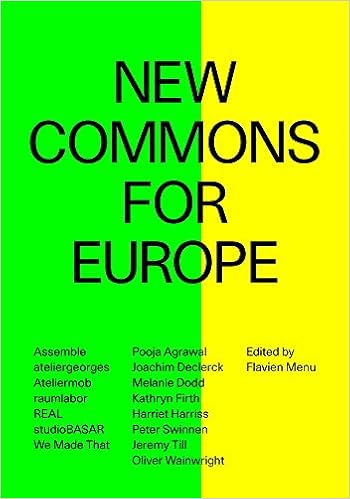
New commons for Europe
In December 2016 the AA (Architectural Association )in London hosted the event “The Bedford Tapes”, which brought together architects and experts from all over Europe. New Commons for Europe captures the vitality and the doubts of a new generation of architects living at a key moment in the history of the European Union and questioning the role of the profession and the architect’s ability to produce projects and spaces for the common good with an alternative set of resources and profit structure. After the conference a series of interviews were conducted with participants in London, Berlin, Brussels, Paris, Lisbon, and Bucharest.The book 'New Commons for Europe' chronicles both the event and the interviews, which have developed into an ongoing European conversation between architectural figures that takes a new reading of the boundaries of the discipline and its interactions with political, economic, and social factors.

Nakayama Hideyuki 1/1000000000
The title of this volume offers a clue as to the approach that Tokyo-based architect Hideyuki Nakayama takes in his practice. The fraction equates to one billionth, and the book’s cover is a diagram of the distance between the earth and the moon. With this realisation, a vector extending from a 10,000-kilometre diameter sphere is instantly traced from the reader’s position. In the architectural world, fractions of this sort are called scales. They magically enable us to move freely in our minds among worlds of various sizes. Interweaving math concepts, history’s great thinkers, and his own projects, Nakayama contemplates this dynamic between something little, yet big.

(Re) Tokyo
[Re] TOKYO explores a wide, understanding vision of the transformative processes of one of the most influential and unknown metropolitan areas in the world, from large scale efforts such as Tokyo's land engineering transformations, to smaller examples such as its capital vending machine system. Four hundred pages, compiling 400 years of history, are covered in this uniquely Japanese complexity of social conurbation, including more than 1400 illustrations, diagrams, photographs, and maps in order to visually support selected themes. [Re] TOKYO develops the idea of [re]definition processes to explain what, who, when, where, and why all these changes took place--a tool to understand its history and speculate about its future as an exciting metropolis and cultural center of the world.



